
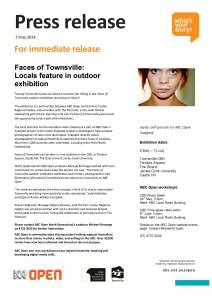
Portrait photos of Graeme and I, larger than life, are back to back in the Flinders Mall lightboxes, Townsville.
Portrait photos of Graeme and I, larger than life, are back to back in the Flinders Mall lightboxes, Townsville.
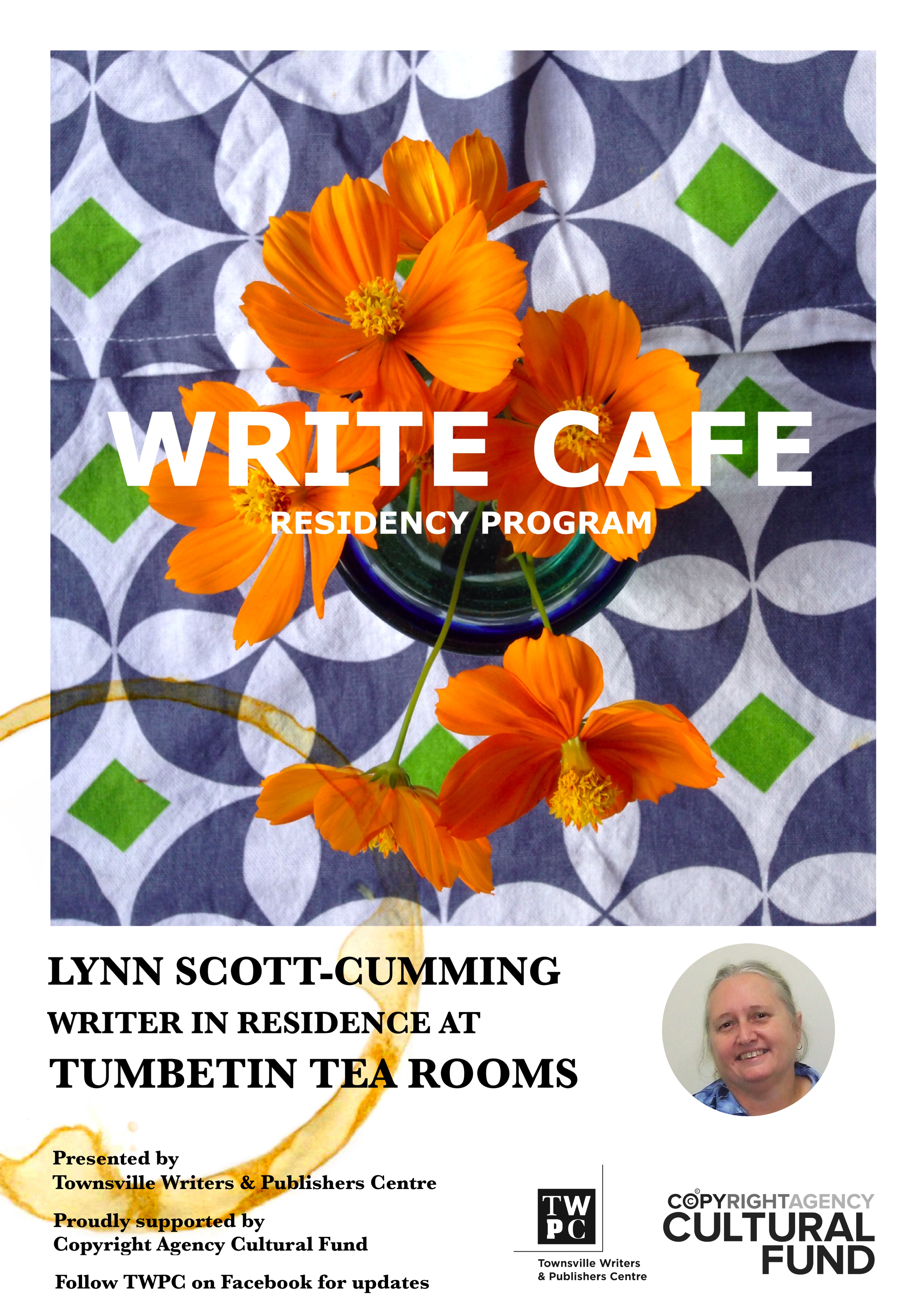
As you can see from the poster, I’m one of the writers hired by Townsville Writers & Publishers Centre to take part in their Write Cafe Residency Program. They were funded by a Copyright Agency Cultural Fund grant. To find out when I’ll be ‘in residence’ at the Tumbetin Tea Rooms follow Townsville Writers & Publishers Centre.
Come the Raw Prawn is on display at the Museum of Tropical Queensland in the Colours of the Coral: Reef Art Exhibition until 31st August 2014
.
Whilst cursing myself and wondering what on earth possessed me to elect to create a gigantic paper mache prawn for an exhibition, I pondered the fact that in the throes of creative passion, many artists throw all caution to the wind. Creative passion cares little for reason, or so it seems. How much does this ability to disregard reason drive the artistic instinct?
Why was I putting so much time, energy, and precious resources into creating a four metre long prawn in a studio space that was way too small? Why was I going to so much struggle to shape bits of paper and bamboo? As I worked, I pondered on what motivated me to make it so large.
I knew I was endeavouring to create a sense of wonder in the viewer, yet I was aware that just making a big prawn would be seen as clichéd and boring. Then I remembered the marvellous sense of wonder I felt as a child when I saw displays of dinosaurs, or whales, or even biplanes, suspended from museum ceilings. Were these childhood emotions behind the apparently irrational desire to create a gigantic creature? Was this why ceilings often looked so inviting to me?
As the artwork’s five segments continued to take shape, in the process occupying much of the lounge and the kitchen, and making our living conditions difficult, my sense of futility, despair, and failure grew.
It wasn’t until, instead of aiming to create a realistic looking prawn, I let my emotions and the materials themselves dictate the process, that I achieved a sense of satisfaction. I finally felt I was starting to achieve my aims when, instead of gluing the curling bits of paper fully down and flush with the body, I let them twist upwards and out, using them and bamboo twigs to suggest the spikes on the head of the prawn. Similarly, I felt far more satisfied when I attached bamboo ‘sheaves’ to the side of the prawn to suggest the ‘armour’ on the legs.
My aim, then, is to capture the essence of a prawn, and to trigger our innate response to one. By allowing the imagination space to ‘finish’ the artwork, I hope to avoid setting off the ‘ho hum, seen it before’ response, which often stops us from enjoying an artwork. I want to set the child in all of us free to imagine, to wonder, and to feel. I believe it is the failure to allow room for the imagination that makes Queensland’s many big objects, such as the Bowen’s Big Mango, seem clichéd.

Recently those of us fortunate enough to have been involved in the ABC Open, Umbrella Studios, and the Great Barrier Reef Orchestra collaborative project to create a video of the mangroves as a backdrop for the Barrier Reef Orchestra’s performance of Peter Sculthorpe’s Mangrove composition have been blogging about the experience. The links to these blogs at ABC Open are: Graeme Buckley (The musicians) will also take you to links for blogs by Sabine Carter (The community orchestra), Nathan Morris (The Sculthorpe composition), Danielle Berry (The collaboration), Jesse Joseph (The performance), Alan Junior (The achievement), and my blog (The artists).
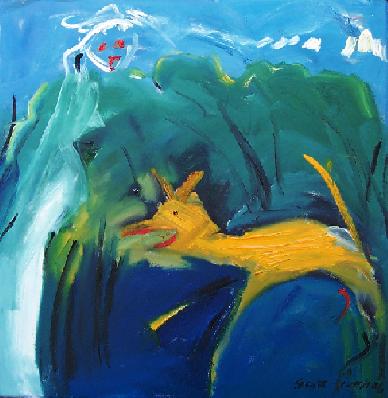
I’m ready for bed but can’t go to sleep, again. So the dogs are growing gooseberries or is that mulberries, or maybe I am just seeing in purple in a field of tiredness. Where does the mind wander when it’s alone in its bed? Where does the mind wander when it’s alone in its head? Can it see the haze stretching out across the acreage and into tomorrow? Can it see me? Can it find me, that unforeseen unknowable being who got lost in the surfaces of thyme and swum through the mirror to the underworld. No Isis of fable, but having more veils.
She dances on tables, just like my dad did. If the cap fits, jam it on your head, else the wind will blow it all away to float on the sea of forgetfulness where a dog swimming is swindled into retrieving a stick. Untie the aquamarine from your eyes and let me use it as a ribbon to bind my hair, that a road into forever is forbearance and introduces formidable knots. If I tried dancing on tables, the veils would tear and down would come Humpty, table and all. But all that’s for another day, on a pinhead, stuck in a pink cushion of silk, hanging from a cobweb of the yellow orb spider that spinner of caraway crazy-eyed dreams. Now don’t you go wiping the window clean for who can see through a clear pane of glass; that way there is naught but the dog still swimming in the sea, carrying my hat over wave and dip and tallow to wash up on the morrow with his head band intact and his feathers down and standing back in the traces
The production of this little video for Video Postcard Project on the ABC Open website was an enormous learning curve for both Graeme and myself. It can be found at:
Geoffrey Smart on an ABC documentary, screened on the 27th November, quoted T. S. Elliot’s ‘still point’ and discussed the value of the written word as opposed to music as opposed to painting. He said it wasn’t until he realized that really good paintings had that ‘still point’, that he understood the true worth of paintings.
I like what Smart had to say. The ‘still point’, the arrested moment, when captured in a painting adds piquancy. It’s the moment when we catch ourselves by surprise.
That fleeting undefinable essence is available to all those who take the time to sit with the painting and listen. Wherein lies the essence of a good painting; it does not give up its secret at first glance and it does not bore with repeated viewing; rather it continues to surprise. It is an invitation, a partially open gate, a shut door, daring the viewer to wander in, or to open the door and step across the threshold into ‘what if’, that wondrous world of imagination and dream.
R.I.P Geoffrey Smart, died peacefully on the 21st June, aged 91.
As I drive over Rooney’s Bridge, the moon’s golden face smiles across the mangrove tree and mudflats, emphasizing their absorption of light. The mudflats, however, eagerly await the dancing tread of the gods. I’m sure if I left the huddle of the car and trudged through the grasses, I would find footprints on the mudflats; as if the gods had just left the ballroom in order to go in search of light refreshments. It seems, too, as if the crabs, whelks, fish, the sleeping birds, and even the most minutiae of inhabitants, await their return, but I am afraid that they have been scared away by invasive humans who now plague the landscape and litter it with glass, plastic, and rusted iron. Only the fruit bats, streaming out from the mangroves in a cloud, to swarm over the city, and raid its trees, seem exempt from the devastation that man has brought, but that is not true either. They have lost many of their roost sites and feeding grounds and so they offend humans by amassing close to residents’ home causing complaints about the noise, the smell, and the risk of disease.
The traffic lights are on red for the cars coming from every direction. Even the train lights are crimson. To the west, the dying orange glow of the sinking sun colours a sky not yet turned indigo. The lights change and we race away, past an oncoming train, and toward the dark barrier of the mountains. The night, which is filled with twilight blue and gold, seems full of potential as it awaits the full moon. It may be that our lunar friend, having crossed the horizon, waits hidden behind buildings, ready to spring out at us.
 Arts Townsville